


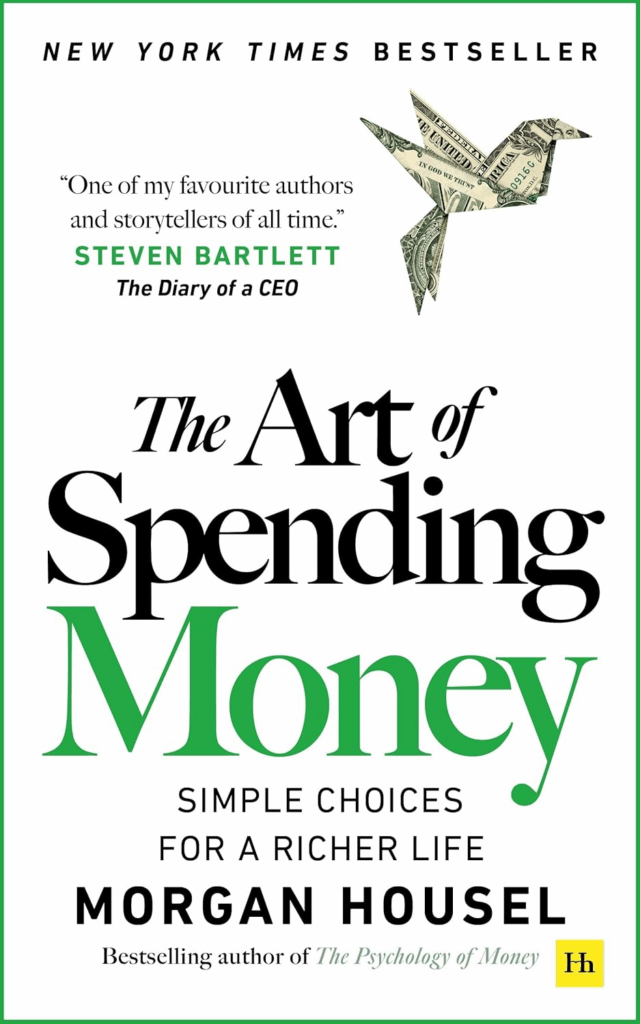
Book Introduction: This is a book on personal finance and the psychology of spending money. It was recommended to me by my son, Aditya. This book is written by Morgan Housel who wrote The Psychology of Money, another great book.
Samir’s Rating: 4 out of 5

The book beautifully articulates the way to rationally approach spending and points the way to maximize happiness and contentment. It also addresses topics such as social debt, utility vs status, and the importance of independence. The reason I did not give it 5 stars was that some portions of the book felt repetitive and some topics that did not seem aligned with the original focus on how to spend money.
Book Summary:
The book starts of by describing how money is a tool for happiness and not an end in itself. He points out that money is like gas in the car. You never want to run out of gas, but you do not want to spend all your life at gast stations. If people were asked to write their obituary, they would never include their bank balance, the size of their home or the horsepower of their car. Therefore, things that we buy are usually an indirect way to enrich our lives with things that we really want – friends, family, health, social relationships.
The book goes on to describe happiness as a gap between expectations and circumstances, and consequently, the need to keep expectations low. Contrast delivers joy. Leading a simple life allows you to enjoy occasional luxury items, otherwise, luxury becomes commonplace. Brain wants dopamine – not cars or houses, it wants to engage in the process and anticipation of getting new stuff, hence living a simple lifestyle keeps delight element going in our daily lives. I really liked this insightful statement: It is really hard to get depressed until your dreams come true. Morgan provides plently of examples of how to maintain happiness and delight in your daily lives.
Morgan then argues the difference between the rich and the wealthy. He contends that rich have money while wealthy are people who can control what money does to your personality, freedom, friendships, morals and mental health. The wealthy often buy things for utility, not status, because they do not need to impress anyone. Buying things for utility gives you the ability to express your identity while chasing status often makes you confirm to others’ identity. Pursuit of status is showing other people what they want to see. People are very different, so why strive for status and comaprison. Pleasure from utility is more durable than pleasure from status.
In the latter part of the book, Morgan proposes that the best way to make life decisions is to minimize future regret. That is a very powerful mechanism to evaluate every financial decision, spend now, or save for later. He emphasizes independence is an important goal that helps people break free of the shackles of the society’s expecations – it helps people decide what to do and when they want to do it. He suggests that the best way to live life is to be rich and anonymous.
Book Opinion:
This book is written in a free flowing style, dotted with tons of examples and interesting quotes. The book is a great sequel to the The Psychology of Money book and a a very engaging read. The chapters flow well from one idea to another.
However, sometimes, a later chapter would repetitively restate an idea from earlier chapters. I felt that the writing could be a little tighter, but then, it might become more formal and the informal writing tone that is effectively used in the book may take a back seat.
Some of the chapters at the end of the book could have been left out for a sharper focus on some the key points in the book. I thought that the book meandered a little at the end and I went through those pages quicker.
Who should read the book?
I highly recommend this book to young adults starting out their career. It will help shape their financial goals and how they can pursue their goals while maximizing what they get out of life. This book is also an eye opener for people who are in the thick of their career pursuing financial independence, and for retirees who want to live the rest of their lives with minimal regret.